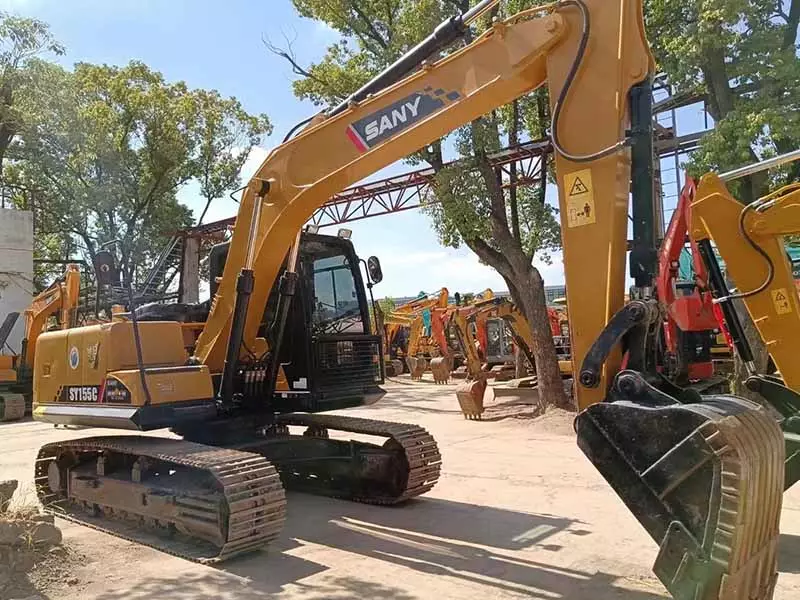
Choosing between these two machines ultimately comes down to your priorities. The Sany SY215C wins on raw digging power and lower ownership costs. In contrast, the Doosan DX225LC delivers smoother hydraulic control and stronger resale value. For budget-driven contractors in high-volume earthmoving, Sany makes clear financial sense. However, if grading precision and long-term residual value matter most, Doosan leads. Browse all 20-ton excavators for sale to compare current available listings.
Pre-Export QC Standards for 20–22 Ton Workhorses
Before export, reputable dealers inspect five critical checkpoints. First, main pump pressure must reach ≥34.3 MPa. Second, engine blow-by pressure must stay below 5.8 kPa. Third, swing bearing axial and radial clearance must remain under 1.7 mm. Fourth, technicians test the main control valve for internal leakage. Finally, undercarriage components must retain more than 50% service life. These thresholds protect buyers from costly post-purchase repairs.

Technical Specification Matrix: SY215C vs. DX225LC
| Specification | Sany SY215C | Doosan DX225LC |
|---|---|---|
| Operating Weight | 21,900 kg | 22,100 kg |
| Engine | Isuzu / Mitsubishi / Cummins | Doosan DL06 |
| Engine Output | 118–128 kW | 116–124 kW |
| Hydraulic Flow | 2 × 222 L/min | 2 × 206 L/min |
| Relief Pressure | 34.3 MPa | 34.3 MPa |
| Bucket Breakout Force | 138 kN | 143 kN |
| Bucket Capacity | 0.93–1.0 m³ | 0.92–1.05 m³ |
Both machines target the same 21–22 ton working class. Nevertheless, their engineering philosophies differ significantly. For a broader model context, read our complete Sany excavator sizes guide to know how the SY215C fits within the full lineup.

Powertrain & Displacement Characteristics
Sany tunes its engine for high RPM and strong peak output. This setup responds fast during heavy loading cycles. On the other hand, Doosan calibrates the DL06 for low-RPM torque, offering smoother acceleration and lower thermal stress. Both approaches perform well, but they suit different job profiles clearly.
Hydraulic System: Kawasaki Positive Flow vs. Doosan e-EPOS Control
Sany SY215C: Dynamic Power Response & Heavy Digging
The SY215C runs a Kawasaki K3V112DT positive-flow pump. As a result, boom lift and bucket curl feel immediate and powerful. This setup excels particularly in hard rock and dense clay environments. Furthermore, the high hydraulic flow rate (2 × 222 L/min) supports fast cycle times consistently. To review current available stock, you can view a used Sany SY215 excavator currently listed for sale.
Doosan DX225LC: Compound Motion Smoothness & Grading Precision
Doosan’s e-EPOS system distributes hydraulic flow with exceptional precision. Consequently, combined boom-arm-swing movements feel fluid rather than abrupt or jerky. Operators report significantly less fatigue during long grading shifts. In addition, fine trenching and slope finishing are noticeably more accurate throughout. Check the available Doosan DH225LC-9 excavator model for current pricing and full condition details.

Fuel Consumption & Maintenance Accessibility
In standard digging mode, the SY215C burns approximately 15.2 L/hr. Meanwhile, the DX225LC consumes about 14.8 L/hr under similar conditions. Over 2,000 annual working hours, Doosan saves roughly $750–900 in fuel costs. That difference remains modest but surprisingly consistent.
Moreover, Doosan’s engine bay offers better access for filter changes and coolant checks. Grease points are also more centralized for faster servicing. In contrast, Sany’s structural components cost considerably less to replace. This lower parts cost offsets higher wear-part replacement frequency on tough job sites.

How to Decide: Sany SY215C or Doosan DX225LC?
Choose the Sany SY215C when you:
- Need the lowest entry price and fastest ROI
- Operate in hard-rock or high-volume bulk earthmoving
- Want cheaper structural wear parts and OEM components
- Work in regions with expanding Sany service networks
Choose the Doosan DX225LC when you:
- Prioritize smooth hydraulic feel and operator comfort
- Focus on grading, pipe-laying, or municipal trenching work
- Plan to resell the machine within three to five years
- Require proven brand recognition in global used equipment markets
For a full breakdown of what each model costs today, see our Sany excavator prices comparison.

FAQ
Q1: Which excavator offers a faster return on investment (ROI), Sany SY215C or Doosan DX225LC?
The Sany SY215C typically delivers a faster ROI. Its purchase price runs 8–12% lower than a comparable Doosan DX225LC. Additionally, wear parts cost significantly less overall. As a result, contractors can recover their capital investment 6–12 months sooner.
Q2: How does hydraulic performance compare between these two models?
The SY215C uses a Kawasaki positive-flow system for aggressive and direct digging response. In contrast, the DX225LC applies e-EPOS technology for smoother compound motions and superior fine-grading control throughout operation.
Q3: Which machine is more fuel-efficient in standard operations?
The Doosan DX225LC holds a clear fuel advantage. It burns roughly 14.8 L/hr versus 15.2 L/hr for the SY215C. Consequently, over 2,000 annual hours, that difference saves approximately $750–900 in fuel expenses.
Q4: What is the typical used price difference between these two models?
At mid-life condition (around 5,000 hours), a used SY215C sells for $28,000–38,000. Comparably, a Doosan DX225LC or DH225LC-9 ranges from $32,000–42,000, depending on undercarriage condition and maintenance history.
Q5: Are spare parts easily accessible internationally for both brands?
Yes. Both brands maintain strong parts availability across Africa, the Middle East, Southeast Asia, and Latin America. Doosan benefits from decades of established global dealer infrastructure. Meanwhile, Sany offers faster structural parts delivery and notably lower OEM pricing across developing markets.