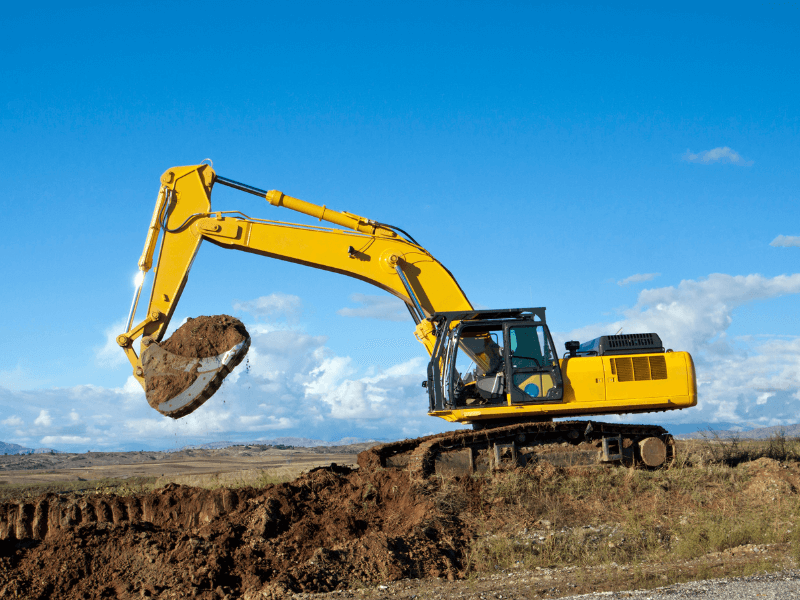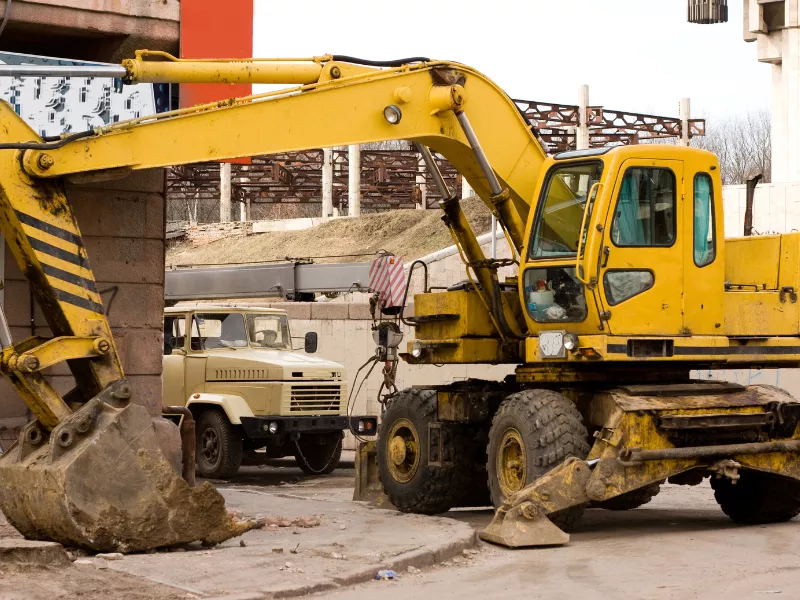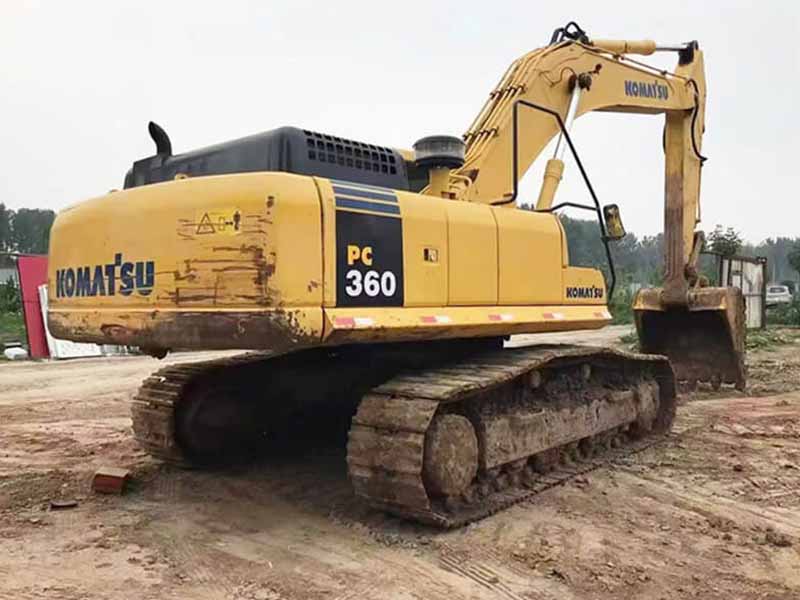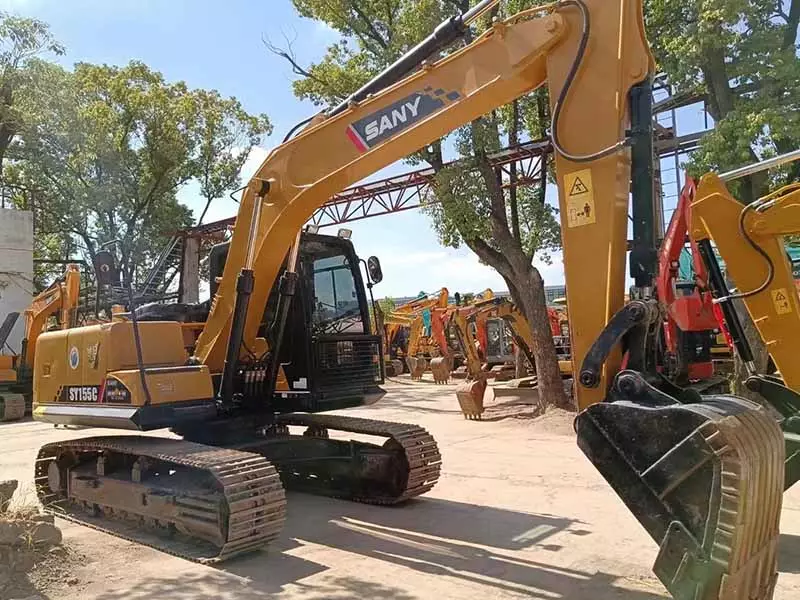
Choosing between these two machines is straightforward once you define your job site. The Kobelco SK125SR wins every tight-clearance urban scenario. Its 1,480 mm tail swing radius lets it rotate a full 360° inside a single 3.5-meter traffic lane. The proprietary iNDr noise and dust reduction system also makes it ideal for night-shift residential work. Meanwhile, the CAT 313C dominates open-site, hard-ground excavation. Its conventional 2,190 mm counterweight delivers longer leverage, stronger side-digging stability, and zero hesitation under an 85 mm hydraulic breaker. For mixed fleets across both conditions, explore compact excavators for sale to compare the full 13-ton lineup.

Technical Specification Matrix: SK125SR vs. CAT 313C
| Parameter | Kobelco SK125SR | CAT 313C |
|---|---|---|
| Operating Weight | 13,200 kg | 13,500 kg |
| Engine | Isuzu / Mitsubishi 68–71 kW | Cat 3054C 74 kW |
| Tail Swing Radius | 1,480 mm (Short Radius) | 2,190 mm (Conventional) |
| Max Dig Depth | 5,340 mm | 5,540 mm |
| Hydraulic Flow | 2 × 130 L/min | 254 L/min |
| Standard Bucket | 0.45–0.50 m³ | 0.52–0.60 m³ |
| Transport Width | 2,490 mm | 2,490 mm |
For a broader look at the full CAT model range, the CAT excavator sizes guide clearly shows where the 313C sits in the lineup.
Tail Swing Geometry & Overhead Clearance Restrictions
The 710 mm difference in tail swing radius is not just a number on a spec sheet. In practice, the SK125SR rotates entirely within the width of its own undercarriage. Therefore, it operates safely beside bridge piers and barrier rails without any risk of counterweight collision. The CAT 313C, however, overhangs the track edge by more than 700 mm. Consequently, even routine swings near concrete columns or guardrails carry real collision risk.
Single-Lane Road Work vs. Heavy Trench Excavation

Kobelco SK125SR: Zero Lane-Obstruction & iNDr Ultra-Quiet Operation
Urban road crews love the SK125SR for one decisive reason: it eliminates the need for full road-closure permits. A set of traffic cones separating one lane is sufficient. This saves substantial permitting fees and avoids costly traffic management delays. Furthermore, the iNDr system channels airflow through an acoustic duct and high-density filter screen. As a result, external noise drops to approximately 93 dB(A), which meets most residential night-shift regulations. If your fleet focuses on municipal pipe repairs, a used Kobelco SK125SR excavator is the most operationally efficient investment in this weight class. Also, read through the complete used Kobelco excavators guide for full SR-series history and inspection tips.
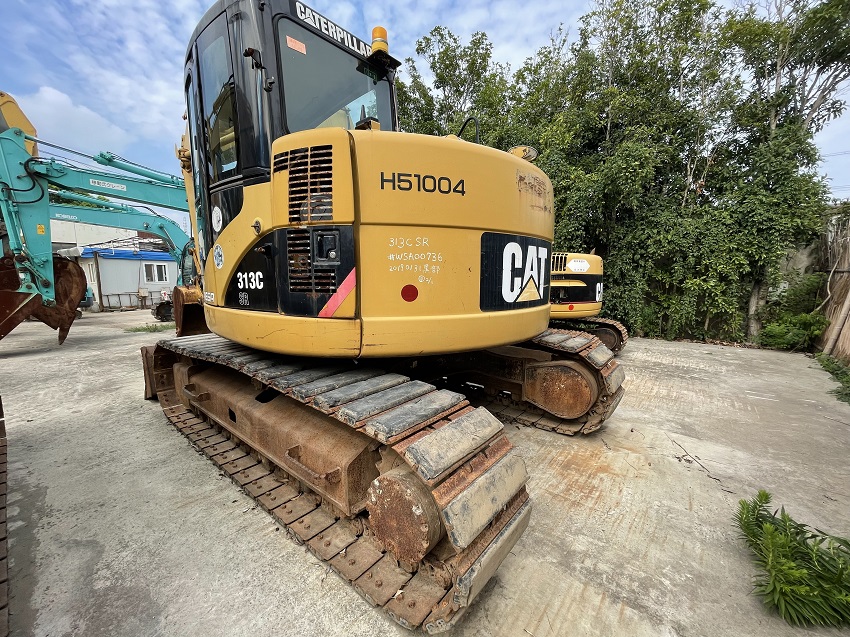
CAT 313C: Long-Leverage Counterweight & Heavy Hydraulic Breaker Stability
In contrast, the CAT 313C excels where raw force matters most. Its conventional rear counterweight creates a longer mechanical leverage arm. This translates to roughly 15–20% greater over-the-side lifting stability compared to short-radius designs. When operators swing heavy loads in hard clay or run continuous breaking cycles on thick concrete slabs, the CAT 313C remains remarkably stable. Additionally, its Cat 3054C engine delivers a consistent 74 kW across the full duty cycle. For heavy trench excavation on rural roads or quarry access projects, a used CAT 313C excavator offers unmatched value at this weight class.
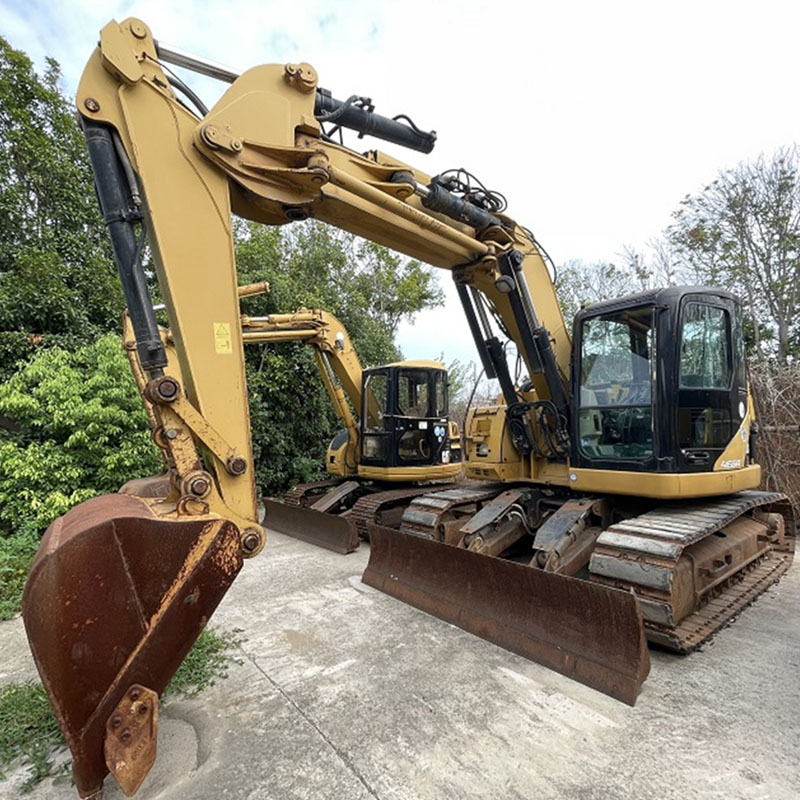
Daily Fuel Consumption & Maintenance Access
Fuel costs separate these machines significantly over a full season. During urban utility trenching, the SK125SR burns roughly 7.6 L/hr, while the CAT 313C consumes approximately 8.9 L/hr. Over 1,500 annual working hours, that gap saves $1,900–2,300 in fuel alone. During continuous breaker operation, both machines consume more — about 10.2 L/hr vs. 11.5 L/hr respectively — but the SK125SR maintains its efficiency edge.
However, maintenance access differs noticeably. The CAT 313C’s wider engine bay allows technicians to reach filters, belts, and pumps without awkward positioning. The SK125SR’s compact layout demands more precision during service intervals. Nevertheless, the iNDr washable wave-screen filter greatly simplifies air system maintenance in dusty environments.

Secondary Market Valuation & Depreciation
| Operating Hours | Used SK125SR Price | Used CAT 313C Price |
|---|---|---|
| 3,000–4,500 hrs | $38,000–48,000 | $32,000–40,000 |
| 4,500–5,500 hrs | $32,000–42,000 | $28,000–36,000 |
| 6,000–7,500 hrs | $24,000–30,000 | $21,000–27,000 |
Short-radius machines consistently command a premium in European, Australian, and Japanese secondary markets. Urban project density in those regions keeps SR-unit demand ahead of supply. The CAT 313C, conversely, moves faster in Latin American and Southeast Asian markets where parts availability and brand familiarity drive purchasing decisions.
How to Choose?
Choose the Kobelco SK125SR when you:
- Work on single-lane municipal roads or highway shoulder repairs
- Operate under bridges, near barriers, or beside residential buildings
- Need night-shift compliance in noise-restricted zones
- Want to avoid full road-closure permit fees
Choose the CAT 313C when you:
- Excavate deep trenches or basements on open, unrestricted sites
- Regularly mount an 85 mm breaker for heavy concrete demolition
- Prioritize wide engine bay access for high-utilization fleets
- Work in rural or export markets where Cat parts supply is strongest
FAQ
Q1: Which 13-ton excavator is safer for single-lane road repairs, Kobelco SK125SR or CAT 313C?
— The Kobelco SK125SR is far safer for single-lane road maintenance. Its 1,480 mm tail swing radius lets it rotate 360° within a standard 3.5-meter traffic lane. The counterweight never intrudes into oncoming lanes during normal operation.
Q2: Does the CAT 313C have better over-the-side stability than the SK125SR?
— Yes. The CAT 313C uses a conventional 2,190 mm rear counterweight layout. This longer leverage arm provides roughly 15–20% greater lifting stability when swinging heavy loads over the side of the tracks.
Q3: What makes the Kobelco SK125SR so quiet for night residential utility work?
— The SK125SR uses Kobelco’s proprietary iNDr system. It routes cooling air through an acoustic duct and dense filter screen. This lowers external noise to around 93 dB(A), which satisfies most residential night-shift requirements.
Q4: How does fuel consumption compare between SK125SR and CAT 313C?
— In urban utility trenching, the SK125SR burns roughly 7.6–8.2 L/hr. The CAT 313C consumes 8.9–9.5 L/hr. That saves approximately 1.3 liters per hour, or $1,900–2,300 annually across 1,500 working hours.
Q5: What is the typical secondary market price difference for used 13-ton compact models?
— At roughly 4,500–5,500 operating hours, a used SK125SR trades between $32,000–42,000. A comparable used CAT 313C sells between $28,000–36,000. Short-radius demand in urban markets drives the SK125SR premium.