Choosing between these two machines comes down to one core question. Do you need maximum truck-loading speed, or maximum rock-breaking stability? The Hitachi ZX350 wins for high-frequency truck loading. It weighs 34,800 kg and uses HIOS multi-pump hydraulics to execute compound swing-and-lift actions 1.2 seconds faster per pass. Over a 10-hour shift, that advantage adds 15–20 extra 30-ton haul truck loads. Meanwhile, the CAT 336D wins for heavy rock breaking. Its 36,800 kg frame and reinforced X-frame chassis absorb 175mm hydraulic hammer recoil without chassis rocking. Before finalizing your fleet decision, explore our full range of 30-ton excavators for sale to match the right machine to your haul trucks.

Technical Specification Matrix: ZX350 vs. CAT 336D
Both machines compete closely on paper. However, key differences drive real performance gaps.
| Specification | Hitachi ZX350 | CAT 336D |
|---|---|---|
| Operating Weight | 34,800 kg | 36,800 kg |
| Engine | Isuzu 6HK1, 202 kW | Cat C9 ACERT, 200–209 kW |
| Pump Flow (total) | 2 × 288 L/min | 2 × 280 L/min |
| Main Relief Pressure | 34.3 MPa | 35.0 MPa |
| Bucket Breakout Force | 237 kN | 244 kN |
| Swing Speed | 10.7 rpm | 9.8 rpm |
| Standard Bucket Capacity | 1.6–1.8 m³ | 1.6–1.9 m³ |
2-Ton Ballast Advantage & Counterweight Dynamics
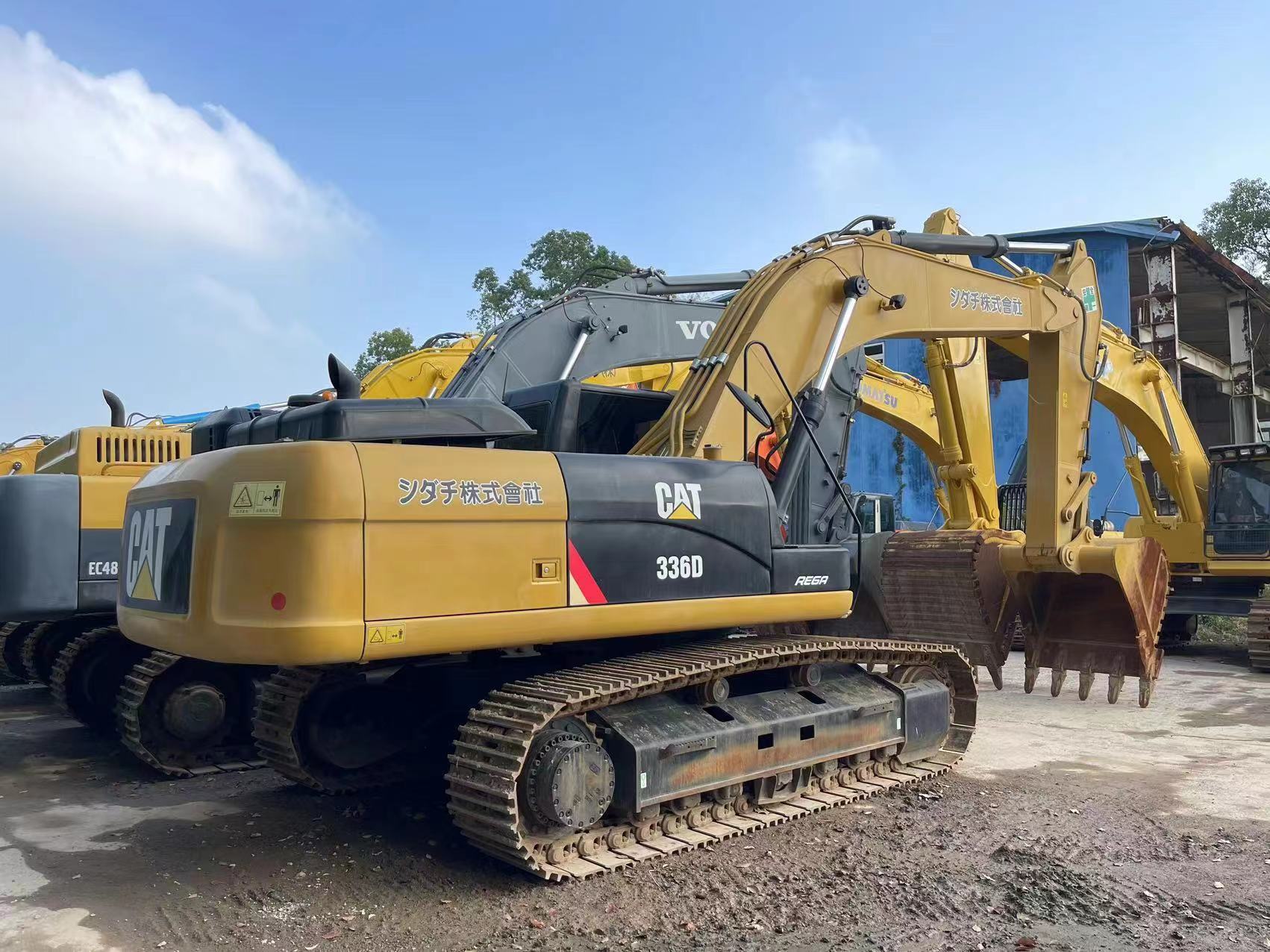
The CAT 336D carries roughly 2 extra tons of structural mass. Consequently, its rear counterweight generates a greater anti-tipping moment during lateral digging. This ballast advantage becomes critical when operators pry apart dense Andean rock formations. For a full breakdown of engine output and hydraulic pressure ratings, review the complete CAT 336 specs guide before committing to a purchase.
High-Frequency Hauler Loading vs. 175mm Breaker Impacts
Hitachi ZX350: HIOS IIIB Multi-Pump Flow & 10-Hour Shift Output
The ZX350’s three-pump architecture is its greatest asset. Specifically, the boom-up and swing circuits run independently and simultaneously. Therefore, the machine never waits for one action to finish before starting the next. In blasted copper overburden loading, each bucket cycle completes in just 11.5 seconds. Compare that with 12.7 seconds for the CAT 336D. Over a full 10-hour shift, this gap produces 8%–10% more total material moved. Contractors ready to inspect available units can view the current used Hitachi ZX350 excavator inventory directly.

CAT 336D: Absorbing Violent Hydraulic Recoil in Andean Rock
The CAT 336D handles heavy breakers exceptionally well. Its cast-pivot boom root and reinforced X-frame fully absorb the shock of a 175mm hydraulic hammer. As a result, operators experience zero chassis rocking during continuous hard-rock breaking. Furthermore, the Cat C9 engine tolerates high-sulfur diesel above 500 ppm reliably. This makes it the preferred choice for remote Bolivian and Peruvian mine sites with inconsistent fuel quality. View current stock on the used CAT 336 excavator page.
Daily Fuel Consumption & Operating TCO
Fuel costs clearly separate these two machines over a full contract year.
- Truck-loading cycles: ZX350 burns ~22.0 L/hr versus ~24.8 L/hr for the 336D.
- Continuous breaker work: ZX350 burns ~25.5 L/hr versus ~28.5 L/hr for the 336D.
Over 2,500 annual mining hours, the ZX350 saves roughly 7,000 liters of diesel. That translates to approximately $7,000–9,500 in direct fuel savings. However, if your site relies on unrefined local diesel, the Cat C9’s mechanical injection system absorbs fuel quality variance far better than high-pressure electronic alternatives.


For a wider regional benchmark on heavy machines, the mining excavator price guide for 30 to 65 ton machines covers current market levels across Peru and Chile.
Secondary Market Valuation in Latin America
Resale value matters greatly for contractors managing fleet rotation cycles. At 6,000 operating hours, a clean CAT 336D in Peru commands $68,000–82,000. A comparable ZX350 fetches $60,000–72,000. That represents a 10–15% Caterpillar resale premium in regional markets. Nevertheless, the ZX350 moves quickly among high-volume earthmoving contractors. Overall demand for used excavators in Peru stays strong across Cajamarca, Arequipa, and northern Chilean copper regions for both models.
Final Procurement Checklist
Choose the Hitachi ZX350 when:
- Your site processes already-blasted, loose copper overburden
- Maximizing truck-loading cycle speed is your top operational priority
- Diesel costs are tightly controlled and every liter counts
- Breaker attachment use stays below 20% of total shift hours
Choose the CAT 336D when:
- You regularly break unblasted hard rock veins or dense ore faces
- A 175mm hydraulic hammer runs for more than 4 hours daily
- Your mine site uses low-grade, high-sulfur local diesel
- Secondary resale value and fast liquidation matter most to you
FAQs
Q1: Which excavator loads mining dump trucks faster, Hitachi ZX350 or CAT 336D?
— The Hitachi ZX350 loads trucks faster. Its HIOS multi-pump system and 10.7 rpm swing speed execute compound movements 1.2 seconds quicker per pass. This directly adds 15–20 extra 30-ton hauler loads per 10-hour shift.
Q2: Why do contractors prefer the CAT 336D for heavy rock breaking?
— The 336D carries 2 extra tons of structural ballast. Its reinforced cast-pivot boom and X-frame chassis fully absorb 175mm hammer recoil without chassis vibration or boom fatigue.
Q3: What is the real fuel consumption difference between these two machines?
— In standard truck-loading cycles, the ZX350 burns 22.0 L/hr versus 24.8 L/hr for the 336D. Over 2,500 annual hours, the ZX350 saves roughly 7,000 liters of diesel, totaling $7,000–9,500.
Q4: How well does the CAT 336D handle poor-quality diesel in remote mines?
— The Cat C9 engine tolerates sulfur levels above 500 ppm without issue. This prevents premature injector failure at remote mine sites where refined diesel is unavailable.
Q5: Which machine holds better resale value across Latin America?
— The CAT 336D commands 10–15% more at resale in Peru, Chile, and Bolivia. At 6,000 hours, it fetches $68,000–82,000 versus $60,000–72,000 for a comparable Hitachi ZX350.