
Choosing between these two machines depends entirely on your job site. The CAT 305.5E2 weighs 5,400 kg and delivers 34.1 kW with 100 L/min hydraulic flow. It dominates hydraulic breaker operations and hard-rock excavation. The Kubota KX71-3, however, weighs only 2,800–3,000 kg. Its compact 1,500 mm body navigates tight alleys, residential yards, and utility trenches with ease. For a broader range of options, explore compact excavators for sale before committing to either model.

Technical Specification Matrix: CAT 305.5E2 vs. Kubota KX71-3
| Specification | CAT 305.5E2 | Kubota KX71-3 |
|---|---|---|
| Operating Weight | 5,400 kg | 2,800–3,000 kg |
| Engine Model | Cat C2.4 | Kubota V1505-E3 |
| Engine Power | 34.1 kW | 20.5 kW |
| Hydraulic Flow | 100 L/min | 67 L/min |
| Max Digging Depth | 3,870 mm | 2,870 mm |
| Bucket Breakout Force | 44.7 kN | 25.2 kN |
| Transport Width | 1,980 mm | 1,500 mm |
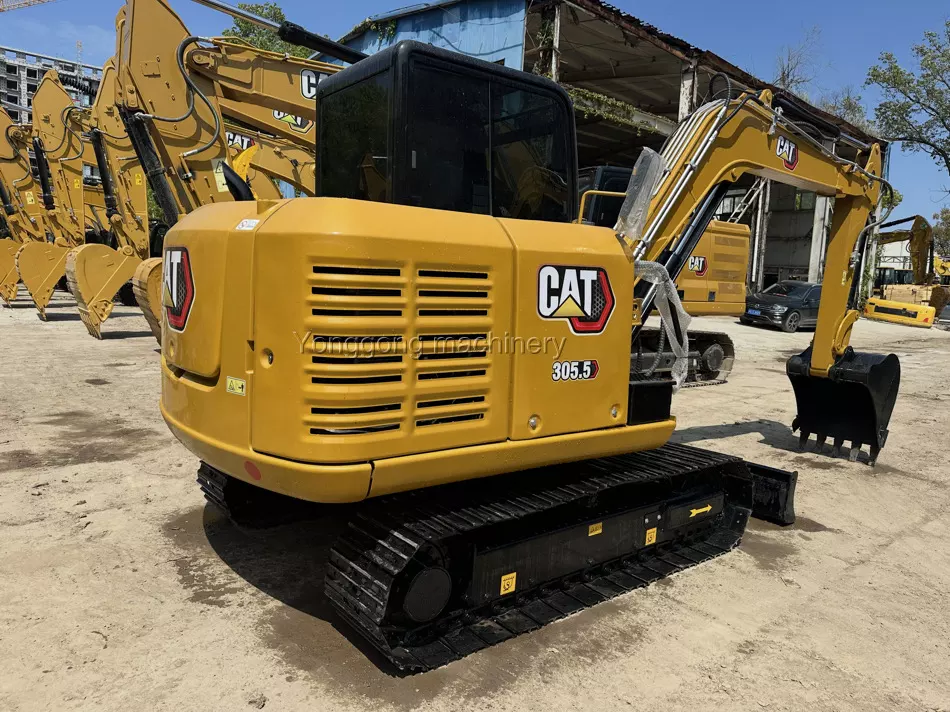
These numbers tell a clear story. The CAT dominates in raw power and reach. The Kubota wins on compactness and job-site accessibility.
Machine Footprint & Transport Convenience
The Kubota KX71-3 loads onto a standard tandem-axle trailer effortlessly. A heavy-duty pickup truck handles the haul. The CAT 305.5E2, however, requires a commercial medium-duty flatbed for legal road transport. This difference matters significantly for crews moving between multiple sites daily. To compare the full Kubota lineup, review Kubota mini excavator sizes before planning your fleet.
Heavy Attachment Capability: Hydraulic Breaker & Augers
Why CAT 305.5E2 Dominates Concrete Demolition
The CAT 305.5E2 handles heavy attachments exceptionally well. Its 5,400 kg frame absorbs recoil from a 68 mm hydraulic breaker smoothly. Additionally, the 100 L/min auxiliary flow sustains high strike frequency throughout the shift. As a result, crews complete concrete demolition jobs faster and with less machine fatigue. Check available used CAT 305.5E excavator units to find a work-ready machine for heavy breaker projects.
Attachment Limitations of Lightweight Mini Diggers
The Kubota KX71-3 struggles with large breakers. Its 2,800–3,000 kg chassis produces excessive recoil under heavy continuous impact. Consequently, operators risk structural fatigue over thousands of hours. Instead, the KX71-3 performs best with thumb buckets, light plate compactors, and small augers on softer ground.
Urban Alleyways & Precision Trenching Agility
Kubota KX71-3: Surgical Digging Between Boundary Walls

The Kubota KX71-3 thrives in tight urban environments. Its 1,500 mm transport width passes through standard residential gates without issue. Moreover, the boom offset function enables flush-against-wall trench cutting. Urban utility crews rely on it daily for water main and gas line installations. Browse current Kubota mini excavator stock for units ready for narrow-access deployment.
Ground Disturbance & Turf Protection
Ground pressure matters greatly on sensitive surfaces. The KX71-3 applies only 26.5 kPa of ground pressure. In contrast, the CAT 305.5E2 pushes 31.2 kPa into the surface. Therefore, the Kubota protects premium lawns and decorative paving far more effectively.
Operating Economy, Fuel Burn & Maintenance (2026 Index)
Fuel costs accumulate quickly on long projects. The CAT 305.5E2 burns approximately 4.8 L/hr under standard trenching conditions. The Kubota KX71-3, however, consumes only 3.1 L/hr. Over 1,000 working hours, the Kubota saves roughly $1,600 in diesel expenses. Furthermore, Kubota’s V1505-E3 engine carries a strong reputation for long-term durability. Meanwhile, CAT benefits from its global parts distribution network, making repairs straightforward almost anywhere in the world.
Pricing & Resale Liquidity
The used market for both models remains active. CAT 305.5E2 units with 2,000–3,500 hours typically sell between $28,000–42,000. Machines with 5,000+ hours still hold solid residual value due to CAT’s global brand recognition. Kubota KX71-3 units in similar condition range from $14,000–22,000. Additionally, the Kubota’s lower entry price attracts independent contractors and small landscaping firms. Browse the latest CAT 305 excavator inventory for current pricing and available hours.

Related reading: residential vs municipal mini excavator guide — specs, hydraulic performance, real-world pricing and maintenance costs compared side by side.
Final Procurement Decision Checklist
Choose the CAT 305.5E2 when you need to:
- Break reinforced concrete slabs or asphalt daily
- Excavate deep utility mains beyond 3.5 meters
- Drive large augers through hard clay or rocky soil
- Sustain heavy-load cycles across full production shifts
Choose the Kubota KX71-3 when you need to:
- Access narrow residential alleys or gated yards
- Protect turf, pavers, and finished landscaping surfaces
- Transport the machine solo with a pickup and trailer
- Keep fuel and operating costs under strict budget limits

FAQ
Q1: Which machine is better for hydraulic breaker operations, CAT 305.5E2 or Kubota KX71-3?
The CAT 305.5E2 is far superior for hydraulic breaker work. Its 5,400 kg frame and 100 L/min auxiliary flow absorb heavy impact forces consistently. The lighter 2,800 kg KX71-3, however, experiences excessive chassis recoil with large breakers. Therefore, it is not suitable for sustained demolition tasks.
Q2: Why do contractors prefer the Kubota KX71-3 for tight urban alley trenching?
The Kubota KX71-3 measures only 1,500 mm wide at transport. It easily enters narrow residential passages and digs flush against boundary walls. The CAT 305.5E2 spans 1,980 mm and simply cannot access these restricted spaces. Consequently, urban utility teams consistently reach for the KX71-3 first.
Q3: What is the fuel consumption difference between CAT 305.5E2 and Kubota KX71-3?
During standard utility trenching, the Kubota KX71-3 burns approximately 3.1 L/hr. The heavier CAT 305.5E2, in contrast, consumes around 4.8 L/hr. Over 1,000 working hours, the Kubota saves roughly $1,600 in diesel expenses. This difference significantly impacts operating budgets on long-term projects.
Q4: How do maximum digging depths compare between the two models?
The CAT 305.5E2 reaches a maximum digging depth of 3,870 mm. The Kubota KX71-3 achieves 2,870 mm. That is exactly 1,000 mm shallower. Therefore, contractors installing deep sewer mains or utility trunks must choose the CAT for adequate reach.
Q5: Can the Kubota KX71-3 be transported on a standard pickup trailer?
Yes, absolutely. The KX71-3 weighs under 3 tons and loads onto a heavy-duty tandem-axle trailer without issue. A standard pickup truck handles the transport safely. The CAT 305.5E2, however, requires a commercial medium-duty flatbed truck due to its 5,400 kg operating weight.


