Choosing between these two machines depends entirely on your job site. The CAT 303.5E CR delivers heavy hammer power with 87.6 L/min hydraulic flow and a 3,690 kg chassis. It excels at deep utility trenching and hard-surface demolition. The Komatsu PC35MR, however, dominates tight residential spaces with true zero-tail-swing design and a lean 2.7 L/hr fuel burn. Both machines represent the 3.5-ton class at its best. Explore compact excavators for sale to compare current available stock before you commit.

Technical Specification Matrix: CAT 303.5E vs. Komatsu PC35MR
| Specification | CAT 303.5E CR | Komatsu PC35MR |
|---|---|---|
| Operating Weight | 3,690–3,780 kg | 3,570–3,650 kg |
| Engine | Cat C1.8 (24.8 kW) | Komatsu 3D88E (22.0 kW) |
| Hydraulic Flow | 87.6 L/min | 70.0 L/min |
| Max Dig Depth | 3,180 mm | 3,110 mm |
| Bucket Breakout Force | 33.0 kN | 29.9 kN |
| Tail Swing Radius | 890 mm (CR) | 875 mm (True Zero) |
| Transport Width | 1,780 mm | 1,740 mm |
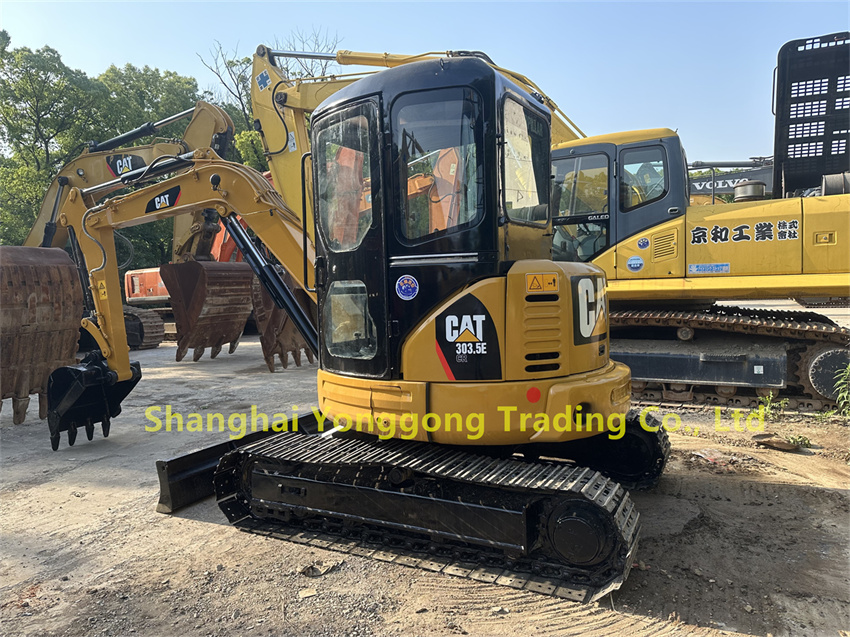
Both machines operate firmly in the 3.5-ton class. However, differences in hydraulic output and tail swing design separate them sharply at the job site.
Undercarriage Wear & Sizing Assessment
Always inspect the undercarriage carefully before buying used. On 3.5-ton machines, check pin-and-bushing play and rubber track wear closely. Excessive sag signals a costly undercarriage replacement ahead. Moreover, measure sprocket tooth wear and confirm roller bracket alignment before committing to a purchase. Our detailed guide to buying used mini excavator covers all critical pre-purchase inspection checkpoints in full.
Heavy Hammer Demolition vs. Zero-Tail Yard Maneuverability
CAT 303.5E CR: Attachment Flow & Concrete Breaker Stability
The CAT 303.5E CR handles hydraulic breakers with impressive on-site stability. Its 87.6 L/min auxiliary circuit drives 45 mm and 53 mm hammers without hesitation. Furthermore, the heavier 3,690 kg chassis absorbs recoil effectively, preventing track lift on hard surfaces. The reinforced boom structure also adds rigidity during repeated hammer impacts. Additionally, the 33.0 kN bucket breakout force tackles dense clay and broken road base with confidence. For contractors running daily demolition or utility pipe jobs, a well-maintained used CAT 303.5E excavator with verified hydraulic pressure delivers outstanding return on investment.
Komatsu PC35MR: True Zero-Tail Swing Along Fence Lines
The Komatsu PC35MR takes a completely different approach to job site access. Its counterweight rotates entirely within the 1,740 mm track width. Therefore, operators swing freely against garden walls, fences, and building foundations without any collision risk. Additionally, the CLSS closed-loop hydraulic system delivers smooth and precise bucket control on soft or landscaped ground. Its offset boom swing also allows flush-to-wall trenching in very narrow driveways. Consequently, residential landscaping crews and single-lane utility teams choose this machine first. Browse the full range of Komatsu compact excavator models available for tight-access and yard-focused operations.

Fuel Consumption, Daily Maintenance & Trailer Towing
Fuel costs accumulate fast on high-hour annual schedules. The CAT 303.5E burns roughly 3.6 L/hr under typical trenching loads. Meanwhile, the Komatsu PC35MR consumes only about 2.7 L/hr. Over 1,000 working hours annually, that gap saves approximately 900 to1,100 in diesel costs. Beyond fuel, daily maintenance on both models is straightforward. CAT service intervals are well-documented, and Komatsu’s filter access sits conveniently within arm’s reach.
Both machines also meet trailer transport requirements easily. Each weighs under 3.8 tons with a transport width below 1.8 meters. Consequently, a heavy-duty pickup paired with a tandem-axle trailer rated at 10,000–14,000 lbs GVWR legally tows either machine across most North American, European, and Australasian regions.
Final Procurement Decision Checklist
Choose the CAT 303.5E when you:

- Run hydraulic hammers or auger attachments regularly on site
- Dig utility trenches exceeding 3.0 meters in depth
- Work in hard clay, road gravel, or broken concrete consistently
- Need maximum bucket breakout force at 33.0 kN
Choose the Komatsu PC35MR when you:
- Operate in dense residential areas with wall or fence constraints
- Prioritize fuel savings across a high annual hour schedule
- Need to protect soft lawns and freshly landscaped surfaces
- Transfer equipment solo using only a standard pickup truck
For a deeper look at the full CAT lineup specs and pricing history, visit our comprehensive CAT 303.5 excavator guide before making your final procurement decision.

FAQ
Q1: Which 3.5-ton mini excavator is better for concrete breaking, CAT 303.5E or Komatsu PC35MR? The CAT 303.5E CR is the stronger choice for hydraulic hammer work. Its 3,690 kg frame and 87.6 L/min auxiliary flow sustain high-frequency breaking without instability. The PC35MR better suits lighter digging and occasional soft breaking only.
Q2: Does the Komatsu PC35MR offer true zero-tail-swing capabilities? Yes. The PC35MR’s counterweight rotates entirely within its 1,740 mm track width. Operators therefore swing a full 360° against fences, walls, and foundations without any contact risk.
Q3: What is the fuel burn difference between the CAT 303.5E and Komatsu PC35MR? The Komatsu PC35MR burns approximately 2.7 L/hr, while the CAT 303.5E uses roughly 3.6 L/hr. That difference saves 900 to 1,100 per year at 1,000 operating hours.
Q4: Can both excavators transport on a standard utility trailer? Yes. Both machines weigh under 3.8 tons with transport widths below 1.8 meters. A heavy-duty pickup with a rated tandem-axle trailer handles either machine legally and safely.
Q5: What is the average used price of a CAT 303.5E versus a Komatsu PC35MR? At 2,500 to 3,500 hours, a used CAT 303.5E typically trades between 24,000 and 32,000. A comparable Komatsu PC35MR sells between 22,000 and 29,000, depending on rubber track condition.